AI and End of Life
This article is not about Skynet and AI ending all life on Earth. 😂
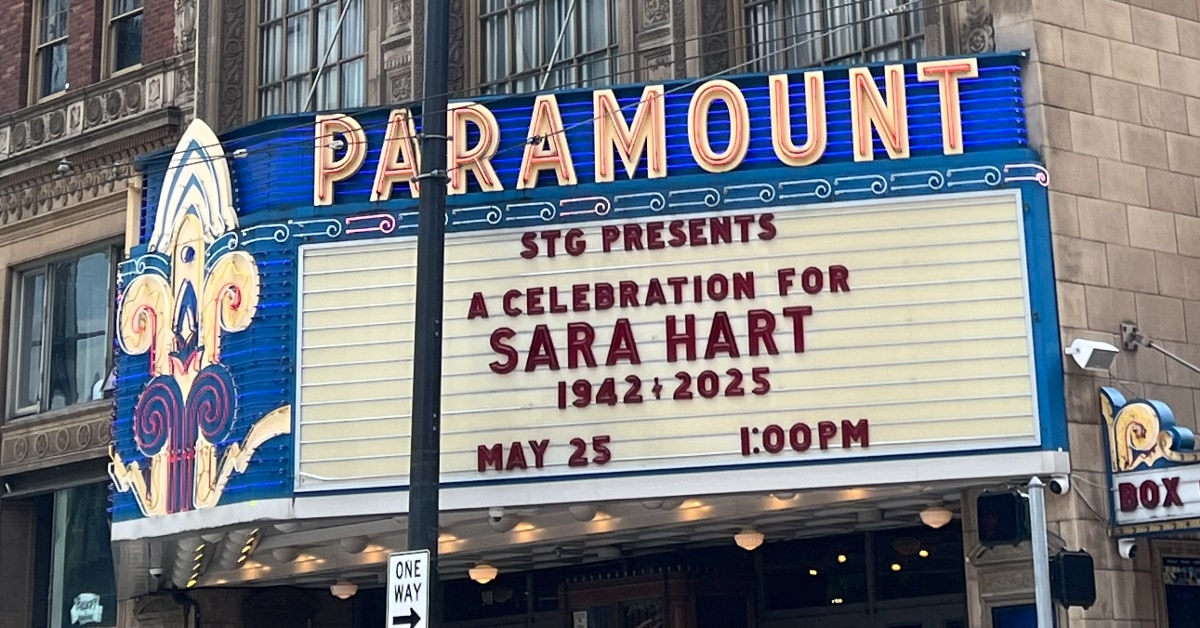
I recently lost my mother. And my job. It’s been a stressful and difficult time, and something I had never really prepared for. I had lots of questions and tasks: managing her estate, dealing with her taxes, dealing with my taxes, organizing her contacts, planning a celebration of life, preparing to livestream the celebration, and even figuring out what I wanted to say for a eulogy.
As an AI enthusiast I instinctively turned to AI to help me navigate these many activities and challenges. I found AI to be an invaluable tool. I’m going to detail how I have been using it over the past few months to assist with end of life tasks.
Data Mining for Contacts 🗃️
As I began planning a celebration of life I wanted to make sure I invited all of my mother’s friends and connections. She wasn’t very organized about her contacts and addressbook—some were in her phone, some were in an email account she shared with my late father, and others were in her gmail account. Still more were scribbled on various notes throughout her office 🤦♂️.
She corresponded with many people who weren’t recorded in her contacts/addressbook, so I knew I needed to scan her emails to find email addresses of personal contacts. I exported and downloaded all of her emails from both accounts, and exported her iPhone contacts. Her MBOX files were gigabytes of data so I knew I couldn’t just upload them to ChatGPT and expect AI to data mine it for me.
I’ve been a Python developer since before the turn of the century, and it’s one of my favorite tools for processing and transforming data. MBOX files and email headers aren’t that complicated to parse, but I wanted to experiment with AI and see if it could speed up my development process.
I asked ChatGPT for its help to write a Python script to process the MBOX files, look for email addresses and store them in a SQLite DB. I also wanted to record some contextual metadata with each occurrence of an email address. Was it from a sender or to a recipient? Were there telltale signs of a listserv in the email headers? How many interactions were there with each email address? I chose SQLite because it’s simple and fast for querying the data (and I wasn’t yet sure what I wanted to query).
I then made a second script to process the SQLite DB and filter for email addresses that matched certain criteria. The script was able to parse a separate list of contacts from an addressbook CSV file, cross reference any email address with it and fill in the person’s name if it wasn’t parsed from the email. And then it output a new CSV with each contact, their first and last name, how many occurrences were found, and whether the address was categorized as personal or listserv. The script also had some filtering parameters to limit the output to only personal addresses, or require a minimum number of occurrences.
Along the way I found discrepancies and anomalies in the output. I worked with ChatGPT to refine the scripts, for instance when I discovered a pattern of email addresses that were re-sent through yahoogroups.com (eg: someone%40comcast.net@yahoogroups.com).
Eventually I arrived at a tool that worked pretty well for my needs. It was able to sort through gigabytes of data and arrive at a list of about 160 contacts which appeared to be real people with whom my mom had interacted with online over the past 25 years. This list became the basis for the invitations I would later send out for her celebration of life.
I’ve published my ContactsScraper on GitHub in case anyone else may find it useful.
Financial Planning 💸
DISCLAIMER: Talk to your attorney and accountant/tax preparer. Do not rely on AI to make any legal or financial decisions.
I inherited a small IRA from my mother, so had lots of questions about what to do here. What is a required minimum distribution? How much is it? What would this do to my taxes? How much debt could I afford to pay off without bumping myself into another tax bracket? Can I afford a new roof for my house? ChatGPT helped me answer a bunch of these questions and model several different scenarios. Then I called my accountant and discussed my plans with her and she confirmed what I had modeled.
I provided as much specific information as I could about my finances and my mother’s IRA to ChatGPT. I’m not going to post any of that information here or any of the results, for obvious reasons. However, I found this to be a valuable process.
As I iterated on the financial models new questions and considerations came to mind. How much interest am I paying on this chunk of credit card debt? How much in additional taxes will I pay by taking a larger IRA distribution, and how does that compare to the interest saved? What if I underpay my taxes? Below are some examples of prompts that I used to figure out how best to use this modest windfall.
Prompt 1: Basic IRA Withdrawal vs. Credit Card Debt Tradeoff 💬
“I have an inherited IRA worth $100,000 and $50,000 in credit card debt at 19% interest. I’m considering taking a distribution from the IRA to pay off the debt. What are the tax consequences of taking out $50,000 in a single year? Should I spread the withdrawals over multiple years to reduce the tax impact?”
Prompt 2: Modeling Partial Withdrawal Strategy 💬
“Assume I’m in the 22% federal tax bracket. If I take $25,000 from my inherited IRA this year and another $25,000 next year, how does that compare (in terms of taxes and interest saved) to taking the full $50,000 this year to eliminate my high-interest debt immediately?”
Prompt 3: Safe Harbor and Withholding Adjustments 💬
“If I take a $40,000 distribution from my inherited IRA and don’t adjust my withholding, could I owe an underpayment penalty? What’s the safe harbor threshold for avoiding a penalty, and how might I adjust my estimated tax payments to stay in the clear?”
This sort of financial modeling is something I usually try to do myself with spreadsheets. Depending on the complexity and my familiarity with the topic it might require an hour of research before I even start writing the spreadsheet. Then as I enter data and model the answer I’ll spend hours more tweaking the spreadsheet columns, cell formatting, formulas, and trying to build a model that would help me visualize and understand different financial scenarios.
In less than half the time it would have taken me to build a bunch of custom spreadsheets by hand ChatGPT helped me by generating charts and graphs, as well as asking clarifying questions that helped me provide better input. ChatGPT was like a financial planner that helped me get hands on with exploring various options.
Creative Support ✍️
“A eugoogalizor, one who speaks at funerals. Or did you think I’d be too stupid to know what a eugoogoly was?” – Derek Zoolander
I’ve never written a eulogy before. I spoke at my dad’s funeral but aside from an anecdote I had thought of the day before it was largely spontaneous and I didn’t write it down. I wanted to plan a more comprehensive and heartfelt eulogy for my mother’s celebration of life.
Let me be clear: I did not use generative AI to write my mom’s eulogy. I did use it to give some broad examples of how to approach it, and what elements to incorporate. It helped me establish an outline and plan to fill 5-10 minutes of time. At a high level:
- Welcome & Thanks
- acknowledge out of town family and those who couldn’t be here
- special thanks to volunteers and key providers of support
- A Difficult Year
- talk about some of the struggles she’d been fighting through
- acknowledge her grace and cheerful disposition through it all
- Her Favorite Things
- talk about some of the decor and memorabilia and how it relates to her
- walk through the themes and give an anecdote or two–aim for some levity
- Who She Was to Others
- mention her career and impact
- mention her volunteer work
- Personal Reflection
- talk about what she did for our family
- the values I learned from her
- how I will remember her
- Closing
- toast to her memory
- invite others to speak
It’s very personal so I won’t share exactly what I wrote, but the above outline really helped me focus my thoughts. It gave my speech a good cadence/flow, and helped me cover many of the essential memories and stories about her that I wanted to share.
One thing I will share is my mom’s love of the Mona Lisa. She collected all sorts of artwork and knicknacks featuring that famous smile. I was planning a livestream of the celebration of life and knew I wanted to feature the Mona Lisa. I used Dall-E to generate a version of the Mona Lisa aiming a DSLR camera at the viewer, upscaled it to a large size and then added a speech bubble and disclaimer text, as you can see below.
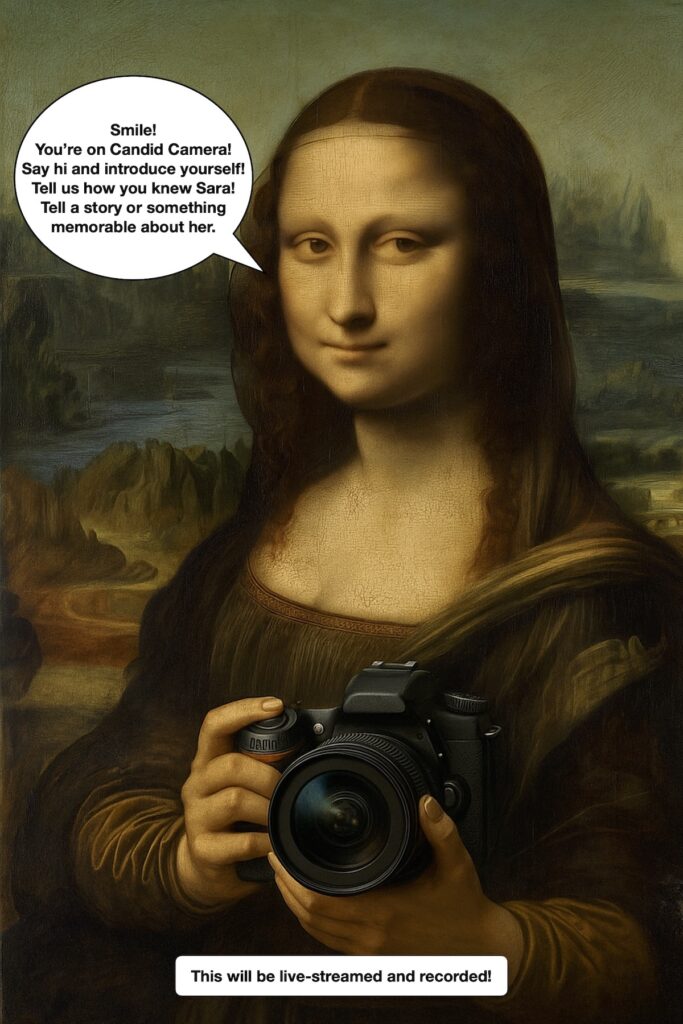
I then had this blown up into a 24” x 36” mounted poster and propped it up next to the livestream station, which I will elaborate on in the next section.
Livestream Planning 📹
I knew many of my mother’s family wouldn’t be able to travel and join us in person at the celebration of life, so I decided to do a livestream and recording of the event. I had never done a livestream before and figured I’d need some near-professional equipment in order to do it right. My kids are interested in becoming YouTubers, so I figured I could invest in some quality equipment for this event and work with them later on their own video streaming content.
Naturally I turned to ChatGPT to help me plan the livestream.
I could probably write an entire article about the hardware, software, various accessories, setup, and event planning. I probably will someday, perhaps the next time I use this equipment to livestream an event. This event was a success and the final edited video of the event was greatly appreciated by many people.
I started by setting a clear goal for ChatGPT: create a professional, reliable livestream setup for your mother’s celebration of life that would both honor her memory and make the event accessible to remote guests. I wanted to not only broadcast and record the eulogies, but also set up a “greeting station” where guests could see a preview of themselves on an iPad and leave a message, story, or greeting for remote guests.
I gave ChatGPT a list of hardware I already had (like my MacBook Pro and iPad Pro), but asked for assistance choosing a good camera, indoor lighting options, microphone(s), tripod, video encoder, and other equipment. For each item ChatGPT usually offered a few different options and recommendations depending on budget and needs.
I definitely spent a few hours researching many of the options (particularly the big ticket items like the camera), but eventually settled on a list of semi-pro equipment that I felt would give me the best bang for my buck:
- Sony ZV-E10 DSLR camera w/16-50mm lens
- Manfrotto 190XPRO 3-Section Aluminum Camera Tripod
- Manfrotto XPRO Ball Head with 200PL Quick Release Plate
- Elgato HD60 X external capture card (usb-c and can stream/record in 1080p60 or 4K30, plus has a HDMI out for an external monitor–making it ideal for when my kids want to livestream their gaming sessions)
- RØDE Wireless ME Microphone System
- RØDE Lavalier II Low-Profile Lapel Microphone
- NEEWER 2 Pack Bi Color 660 LED Video Light
- SanDisk 128GB Extreme PRO SDXC UHS-I Memory Card
On the software side of things ChatGPT recommended OBS, an open-source streaming/recording tool which was a breeze to set up and connect to YouTube. For post-production and editing the recorded footage into a polished video I used iMovie. It’s pretty basic, but is free with macOS. I think next time I do something like this I may invest in Final Cut Pro, but as I’m not a pro who does this for a living I think Adobe Premiere Pro is probably overkill.
ChatGPT even offered to make a “day of” checklist for me to help me configure the whole end-to-end livestream setup. I didn’t bother with this but did ask a few troubleshooting questions (eg: about XLR to TRS microphone conversion) while setting up at the event.
Overall the event was a wonderful gathering of people and sharing of memories and stories about my mother. I don’t know that many remote relatives tuned in to the livestream, but they definitely appreciated the edited recording I eventually created and shared.
Post-Production Challenges 🎛️
A few days later I sat down in front of my MacBook intending to do a little editing and create a version of the celebration of life which I would post to YouTube and share with family and friends. This is when I discovered the audio was terrible.
I thought I had correctly connected to the in-house AV system using a jury-rigged XLR to TRS converter for the microphone. However it sounded like the only audio that was picked up was from the camera’s built in mic. It captured the sound from the house speakers–as well as any nearby chit-chat, laughter, or applause from guests.
With a few suggestions from ChatGPT I was able to manually clean up the audio enough that the eulogizers were mostly intelligible:
- Apply the “Enhance Audio” feature
- Use the “Voice Enhance” filter
- Reduce Background Noise (40% worked pretty well in my case)
- Lower Gain or Volume on Peaks (manually select moments of applause or laughter and reduce the gain)
I also came up with a shopping list of additional microphones and equipment (like a good XLR to TRS converter) so that next time I livestream an event I would be prepared.
Final Thoughts
What I found during this whole process was that AI can not only be a valuable resource for dealing with the variety of unexpected questions and issues that may come up when you have lost someone, but surprisingly I think it helped me cope with the grief.
I spent a lot of time on my computer working on the tasks detailed in this article–and through it all AI appeared to lend a supportive and sympathetic ear. AI helped me stay focused on the tasks I needed to get done and create a wonderful memorial for my mother.
What surprised me the most about AI’s capabilities was how natural it felt. It almost felt like a friend on the other side of a chat app who was there to help me figure out how to manage anything that came up–whether it was finances, tech, or how to write a eulogy. Other times AI was simply there to cheer me on and celebrate a small success.
AI is being incorporated into everything, but I don’t think I’ve seen it used for end of life planning and services. It makes me wonder if there is an opportunity here for a startup.
I’d love to hear how you have used AI to navigate end of life issues. Do you know of a startup that works in this space? I think this is an interesting and possibly untapped area for AI.